



Healthcare and pharma trends in H1 2026 point to a common strategic change: scientific innovation increasingly needs to be matched by effective real-world delivery.
Across oncology, hematology, cardiovascular disease, endocrinology, obesity, neuroscience, immunology, respiratory medicine, women’s health, rare diseases, cell and gene therapy, vaccines, public health and AI, progress is increasingly being decided by patient selection, treatment convenience, manufacturing, reimbursement, access and healthcare-system readiness.
Precision medicine is becoming more practical, competition is expanding beyond efficacy, and diagnostics and AI are moving healthcare further upstream toward prediction and prevention.
For pharmaceutical and healthcare leaders, the implication is clear: regulatory approval increasingly represents a commercial starting point, not the end of the innovation process.
For historical context: Explore our H2 2025 Healthcare and Pharma Trends Report to see how the trends shaping the sector in the previous half-year have evolved into H1 2026.
Key Findings: Five Healthcare and Pharma Trends that Defined H1 2026
- Execution is becoming a competitive capability. Manufacturing readiness, reimbursement, infrastructure and patient access increasingly influence whether clinical and regulatory progress translates into sustainable real-world use.
- Precision medicine is becoming operational. Oncology biomarkers, neuroscience diagnostics, pathway-specific immunology, respiratory biomarkers and individualized genetic approaches are increasingly guiding patient selection and development.
- Competition is expanding beyond efficacy. Oral and subcutaneous delivery, less-frequent dosing, durability, treatment burden and ease of administration are increasingly relevant across obesity, endocrinology, hematology, immunology and rare diseases.
- Scalability is becoming part of platform value. Cell and gene therapy depends increasingly on CMC, GMP manufacturing, vector production and process development, while vaccine technology transfer and regional manufacturing connect innovation with supply resilience and access.
- Healthcare is moving upstream. Cardiovascular risk assessment, neuroscience biomarkers, blood-based detection, public-health surveillance and AI-enabled screening are increasing the strategic importance of identifying risk and disease earlier.
Together, these developments suggest that the defining competitive question in 2026 is not simply who can innovate, but who can connect scientific progress with evidence, delivery, access and sustainable implementation.
Explore the H1 2026 Healthcare & Pharma Trends Report
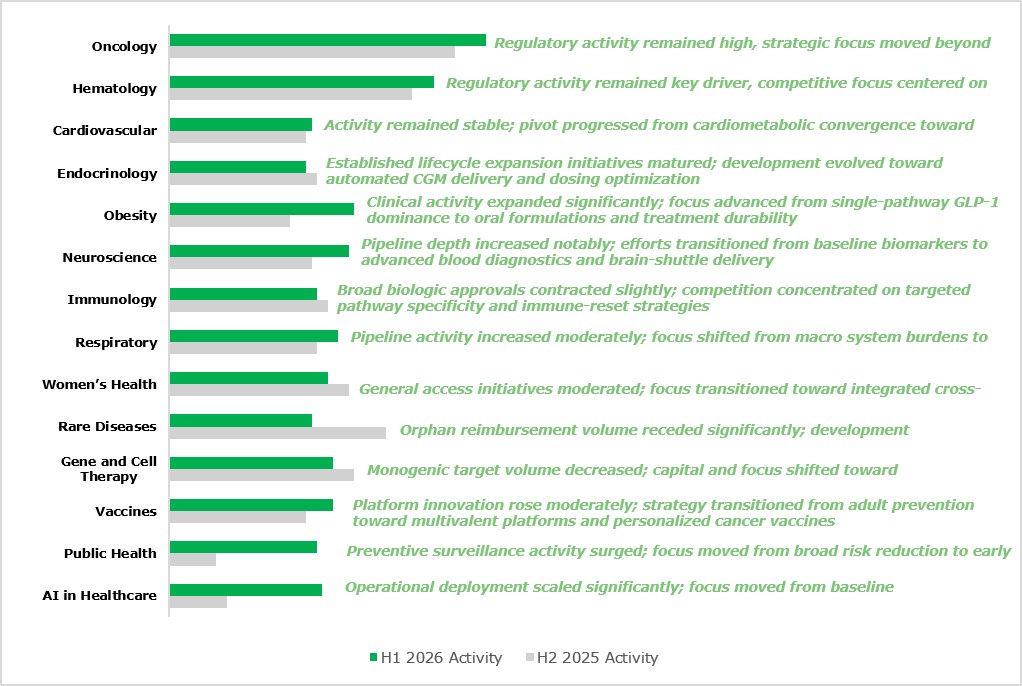

Activity-intensity scores are qualitative indicators reflecting relative discussion volume, strategic emphasis and execution relevance in LucidQuest Intelligence analysis; they do not represent counts of trials, products, deals or approvals.
Oncology and Hematology Trends: Earlier Treatment Raises the Importance of Sequencing and Delivery
Oncology and hematology competition increasingly centers on positioning, sequencing and delivery as therapeutic options expand and move into earlier settings.
In oncology, ADCs including ENHERTU, PADCEV, Datroway and Trodelvy featured alongside checkpoint inhibitors, while HER2, EGFR, BRAF, ESR1, ROS1 and MET supported more specific patient selection. As targeted therapies move into first-line, neoadjuvant, perioperative and adjuvant settings, biomarker-defined selection becomes more important to deciding which patients receive treatment, when, and in what sequence.
In hematology, multiple myeloma remains a major focus, with DARZALEX, TECVAYLI, Blenrep, Sarclisa and BCMA- and GPRC5D-directed approaches contributing to a more complex treatment environment. CAR-T, CAR-NK and gene therapies broaden possibilities, but manufacturing, supply and reimbursement can affect availability. At the same time, subcutaneous, self-administered and all-oral regimens make convenience an increasingly relevant differentiator.
Cardiovascular, Endocrinology and Obesity Trends: Chronic Care Moves Toward Earlier and Simpler Intervention
Cardiovascular disease, endocrinology and obesity increasingly converge around prevention, convenience and technology-enabled chronic care. Cardiovascular innovation spans structural interventions such as TAVR, tricuspid therapies, pacing and thrombectomy, while coronary calcium, Lp(a), ApoB and women-focused assessment support earlier risk identification. Remote monitoring, wearables and AI-supported screening further connect detection with ongoing management.
Endocrinology is similarly reducing chronic treatment burden through once-weekly insulin, weekly growth hormone, oral programs, continuous glucose monitoring, predictive analytics and automated insulin delivery. Type 1 diabetes development also extends beyond insulin replacement through cell therapies, engineered Tregs, immune modulation and gene-based approaches.
In obesity therapeutics, GLP-1 therapies remain central, but oral programs, dual and triple agonists, amylin combinations and RNA interference broaden development. Competition is expanding beyond weight loss to durability, maintenance, dosing frequency, muscle preservation, visceral-fat reduction, pricing and access. Generic semaglutide, regional manufacturing and patent expiries in India, China and Canada further connect clinical differentiation with affordability and commercial execution.
Neuroscience, Immunology and Respiratory Trends: Precision Medicine Requires Better Targeting and Delivery
Neuroscience, immunology and respiratory medicine show precision medicine becoming more practical through biomarkers, pathway selection and better delivery.
In neuroscience, brain-shuttle antibodies, TfR1-enabled AAV capsids and brain-penetrating formulations address CNS delivery barriers, while ApoE4 and neurofilament light chain testing strengthen patient characterization and monitoring. The strategic relationship is important: better diagnostics improve selection, while improved delivery increases the ability to act on biological precision.
Immunology is becoming more pathway-specific through IL-23, TYK2, BTK, FcRn, OX40L and TL1A approaches, while oral therapies, subcutaneous self-administration and longer dosing intervals increase the importance of convenience. CAR-T and allogeneic NK-cell approaches in autoimmune disease also explore deeper immune-reset strategies.
In respiratory medicine, STAT6, IL-33 and TSLP programs, gene and RNA approaches in AATD and cystic fibrosis, and AI-enabled imaging and biomarkers connect targeted biology with improved stratification and treatment selection.
Women’s Health and Rare Disease Trends: Personalization Extends Across the Patient Journey
Women’s health and rare disease development show that personalization increasingly extends beyond the therapeutic target to diagnosis, formulation, access and care delivery.
In women’s health, HER2-, TROP2- and ESR1-directed strategies and ADCs advance precision in breast and gynecologic oncology, while endometriosis, fertility, contraception, menopause and reproductive access broaden the field toward a lifecycle model. Women-specific AI models and digital pregnancy platforms add a delivery dimension to that shift.
Rare disease development combines gene therapies, RNA approaches, small molecules and biologics with oral, subcutaneous and less-frequent formulations designed to reduce lifelong treatment burden. Natural-history controls, surrogate endpoints and tailored regulatory frameworks can be particularly relevant where conventional trials are difficult. Yet precision does not guarantee access: individualized genetic medicines and personalized CRISPR approaches may target exceptionally small populations, making reimbursement, specialty pharmacies and patient-support infrastructure important to real-world reach.
Cell and Gene Therapy and Vaccine Trends: Scalability Becomes Part of Platform Value
Cell and gene therapy and vaccines demonstrate why manufacturing and delivery are becoming part of platform value. In cell and gene therapy, CMC requirements, GMP manufacturing, vector production and process development can influence regulatory timelines and commercialization across rare diseases, oncology, autoimmune disease and CNS disorders. Manufacturing readiness therefore cannot be separated from clinical development.
Allogeneic CAR-T, CAR-NK, Treg and engineered iNKT approaches reflect efforts to create more scalable advanced therapies, while in vivo platforms using lipid nanoparticles, circular RNA and viral delivery explore whether therapeutic cells can be generated directly inside patients. Vaccines show a parallel focus on scalable platforms through combination and multivalent approaches, RNA technologies, nanoparticles, adjuvants and intranasal delivery. Regional manufacturing and technology transfer in India, Mexico and Colombia connect vaccine innovation with supply resilience, while personalized neoantigen vaccines and AI-guided antigen selection extend the platform into cancer.
AI in Healthcare and Public Health: Prediction and Prevention Move Closer to Routine Care
AI in healthcare and public health increasingly converge around earlier risk identification, disease detection and intervention. Clinical AI spans documentation, coding, imaging, screening, monitoring and decision support, while pharmaceutical applications extend across target discovery, drug design, clinical trials and manufacturing. AI is therefore becoming less of a standalone category and more of an enabling layer across care and R&D.
Agentic AI increases the importance of governance, safety, validation and integration as systems become capable of more task-oriented workflows. Public health is moving upstream as well: lifestyle and environmental risk, blood-based biomarkers, ctDNA and cfDNA, infectious-disease surveillance, zoonotic threats and antimicrobial resistance all reinforce the value of earlier detection and prevention. At the same time, AI-generated medical advice, fabricated diseases, false citations and misinformation make trustworthy evidence and governance essential.
Healthcare and Pharma Trends to Watch in H2 2026
- Oncology and hematology: earlier-line sequencing, combinations, biomarker positioning, manufacturing and access.
- Cardiovascular, endocrinology and obesity: earlier intervention, automation, oral formulations, durability, maintenance and access.
- Neuroscience, immunology and respiratory medicine: whether biomarkers, delivery technologies and pathway-specific mechanisms improve patient selection and treatment strategy.
- Women’s health: whether lifecycle approaches produce more integrated models across oncology, reproductive health, menopause and digital care.
- Rare diseases and cell and gene therapy: evidence requirements, safety, manufacturing scalability, regulation, reimbursement and frameworks for individualized therapies.
- Vaccines: multivalent and combination strategies, regional manufacturing, adult immunization and therapeutic cancer vaccines.
- AI and public health: validation, governance, system integration and evidence quality as predictive and increasingly autonomous technologies move closer to routine use.
H1 2026 Shows Why Execution Is Becoming the New Healthcare Innovation Test
H1 2026 shows a growing interdependence between scientific innovation and the systems required to translate it into patient impact. Across all 14 areas, the strategic direction is consistent: precision must connect with delivery, advanced modalities with scalability, chronic care with convenience, and prediction with trusted evidence.
For pharmaceutical and healthcare decision-makers, clinical and regulatory milestones remain essential, but they represent only part of the value equation. Sustainable impact increasingly depends on connecting evidence with the right patient and treatment pathway, scalable manufacturing, reimbursement, access and healthcare-system readiness.
Access the Full H1 2026 Pharma and Healthcare Trends Report
The complete report provides in-depth analysis
Explore the key trends shaping pharma and healthcare in H1 2026, including:
- How industry priorities have shifted from innovation toward delivery, access and real-world execution
- How activity and strategic focus have evolved since H2 2025
- The key and emerging trends across 14 major therapy areas and healthcare sectors
- Where AI, precision medicine, advanced therapies and prevention are changing development and care
- The commercial, regulatory, access and delivery factors shaping what comes next
Download the full H1 2026 Pharma and Healthcare Trends Report
Stay current with our Strategic Roundups