

The mobile health app landscape is expanding, but space growth is moving faster than clinical maturity. Across the 14 therapy areas assessed by LucidQuest in H1 2026, the most developed capabilities remain patient-facing: education, symptom and physiological tracking, medication support, personalization, and health data management. More advanced capabilities such as remote monitoring, clinical decision support, wearable integration, connected care, and clinical validation remain substantially less mature.
This gap defines the strategic direction of mobile health apps in 2026. The market is no longer short of disease-focused digital tools. The greater opportunity is to move beyond standalone self-management by connecting patient engagement and increasingly sophisticated digital functionality with stronger evidence and healthcare delivery.
Key Findings
- Cardiovascular is the largest mobile health app landscape, with 281 apps in H1 2026.
- App growth varies considerably across therapy areas and reporting periods.
- Self-management and tracking are the most mature digital capabilities.
- AI adoption is increasing but remains uneven.
- Clinical evidence remains the clearest maturity gap.
Explore the Full H1 2026 Mobile Health App Analysis
Access the complete LucidQuest report for a detailed assessment of the mobile health app landscape across 14 therapy areas.
Access the report:
H1_2026_Exploring_the_Health_Mobile_Apps_Space_by_LucidQuest
Mobile Health App Growth Is Concentrated Across a Few Therapy Areas
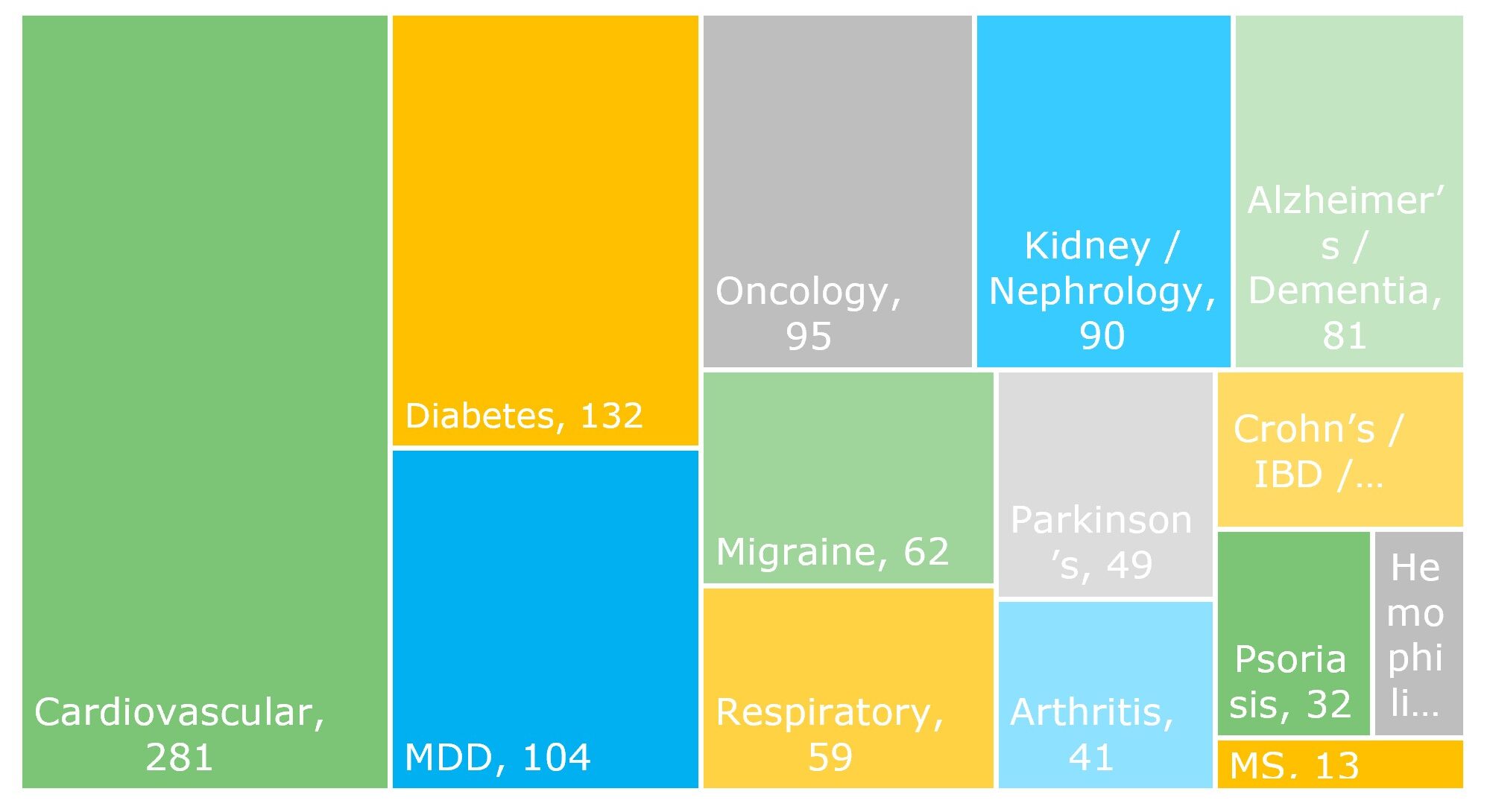
The first strategic divide is scale. Cardiovascular is the largest space in the LucidQuest analysis, with 281 apps in H1 2026, more than twice the 132 identified in diabetes. Major Depressive Disorder (MDD) follows with 104 apps, oncology with 95, kidney health with 90, and Alzheimer’s disease and dementia with 81. At the other end of the spectrum, hemophilia has 19 apps and multiple sclerosis only 13.
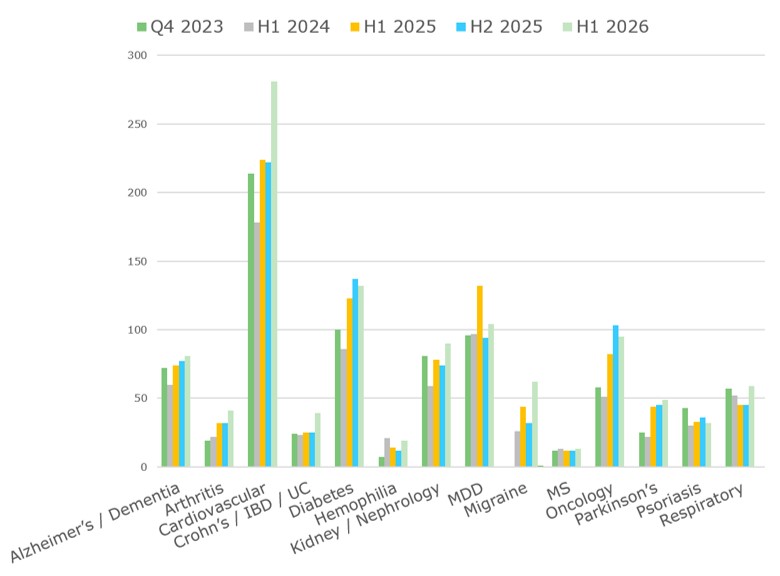
Looking across reporting periods, app growth has not been consistent across therapy areas. Cardiovascular and Diabetes have remained among the largest app landscapes, while Migraine, Arthritis and Parkinson’s have expanded substantially from smaller bases. Several therapy areas have also experienced periods of acceleration, stabilization or decline, showing that longer-term growth does not necessarily translate into continuous period-to-period expansion.
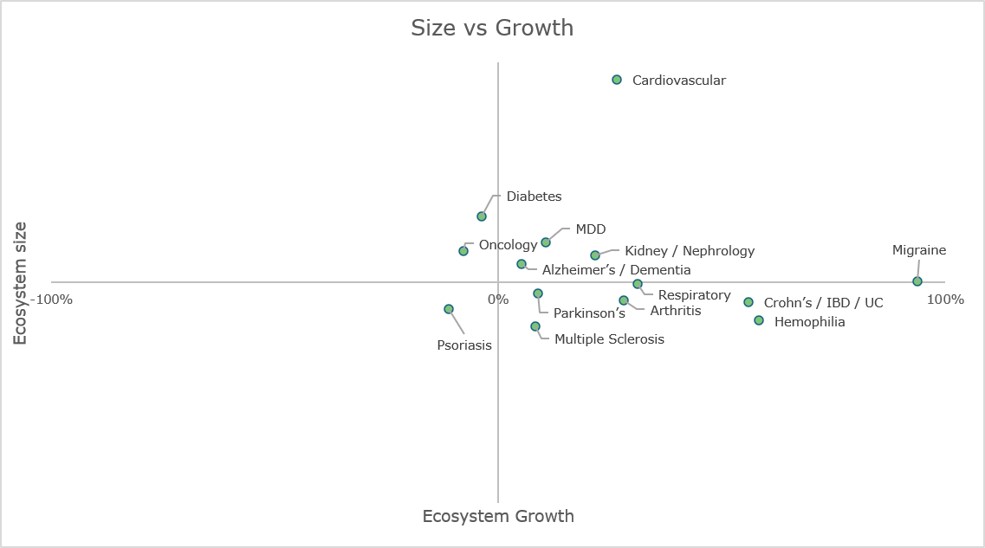
Growth presents a different picture. Cardiovascular expanded 26.6% from H2 2025 while already operating from the largest base. However, some of the highest growth rates occurred in smaller spaces: migraine increased 93.8%, hemophilia 58.3%, and Crohn’s disease, inflammatory bowel disease and ulcerative colitis 56.0%. Diabetes and oncology remained among the largest categories but contracted by 3.6% and 7.8%, respectively, while psoriasis declined 11.1%.
Explore the LucidQuest Mobile Health Apps Report Series for additional analyses across reporting periods.
The divergence between scale and growth means app numbers alone provide an incomplete measure of digital maturity. Large spaces can continue expanding around established functionality, while smaller categories can grow rapidly from a limited base. For healthcare and pharmaceutical stakeholders, the capabilities and evidence behind those applications may therefore be more strategically informative than space size alone.
Looking at longer-term growth alongside current app numbers highlights different trajectories across therapy areas, with some smaller categories expanding rapidly while larger categories show more moderate growth.
Self-Management and Tracking Define Current Mobile Health App Maturity
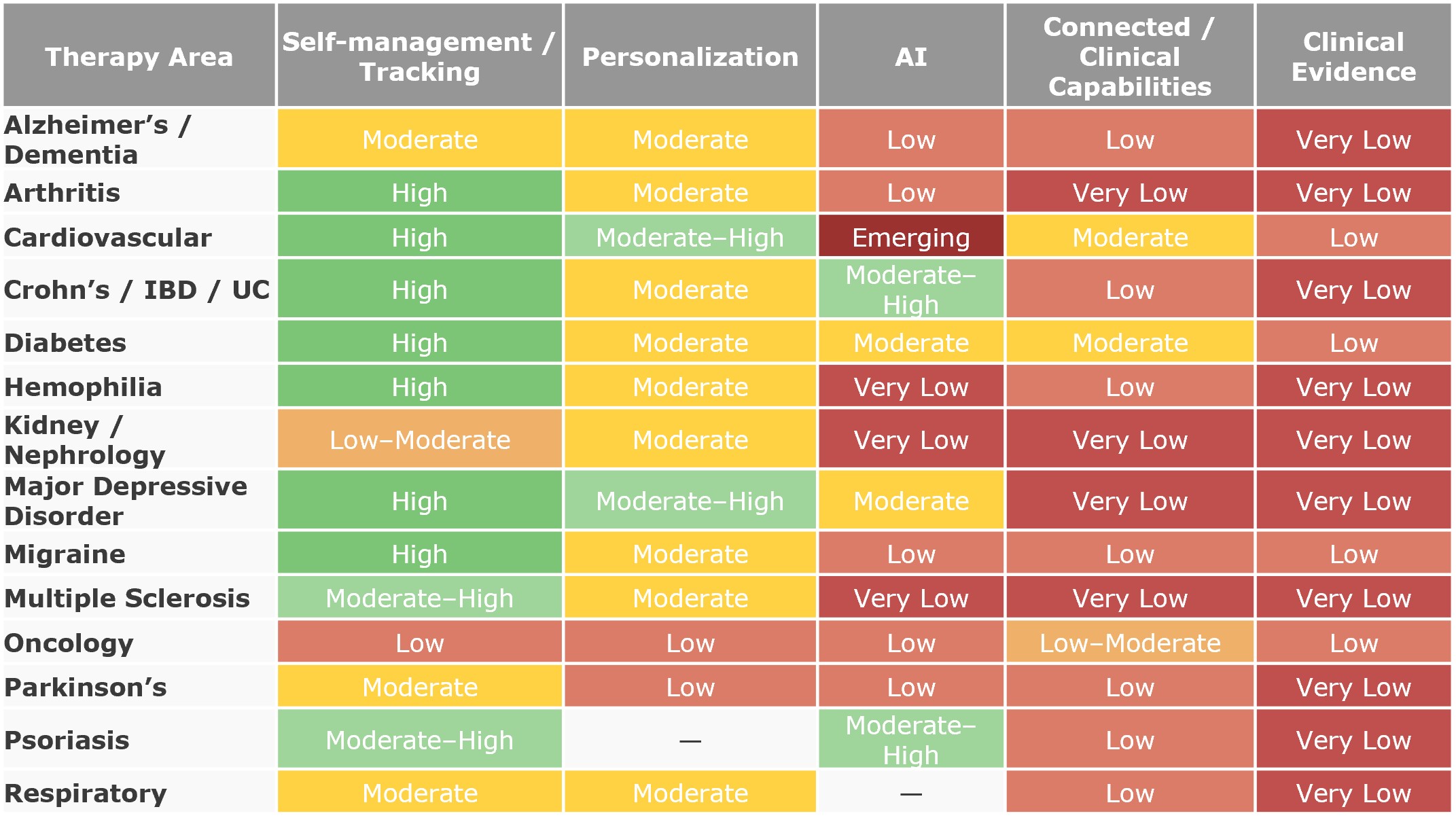
Self-management and tracking are the most mature capabilities across the mobile health app landscape. LucidQuest classified these capabilities as highly mature in multiple therapy areas, including arthritis, cardiovascular disease, Crohn’s/IBD/UC, diabetes, hemophilia, MDD, and migraine.
Crohn’s/IBD/UC illustrates how strongly the space remains anchored in patient self-management. Education appears in 69% of the 39 apps analyzed, while symptom tracking and food or diet logging each appear in 51%. Personalization reaches 39%, but wearable or device integration falls to 13%, clinical decision support to 5%, and none of the apps explicitly describe remote monitoring.
Hemophilia shows a similar pattern. Symptom tracking, medication tracking, and patient education are each available in 47.4% of its 19 apps. In contrast, report generation appears in 15.8%, clinical decision support and healthcare integration in 10.5% each, and AI, wearable integration, and remote monitoring in only 5.3%.
The pattern suggests that mobile health has established a strong foundation for helping patients record symptoms, manage treatments, access information, and understand their disease between interactions with healthcare providers. The strategic question is increasingly whether these capabilities can progress from standalone patient support toward more connected roles in disease management.
AI Adoption in Mobile Health Apps Is Emerging but Remains Uneven
Artificial intelligence is becoming a more visible differentiator in mobile health apps, but adoption varies considerably between therapy areas and does not yet represent a consistent measure of space maturity.
Crohn’s/IBD/UC and psoriasis are among the stronger examples. Explicit AI functionality appears in 36% of Crohn’s/IBD/UC apps and 34.4% of psoriasis apps. In psoriasis, AI is primarily associated with skin-image analysis, condition recognition, and personalized insights. MDD also shows an emerging AI presence, with 26.9% of its 104 apps explicitly communicating AI capabilities.
Other spaces remain further behind. Arthritis has AI functionality in three of 41 apps, or 7.3%, while Alzheimer’s disease and dementia has explicit AI or machine-learning functionality in only three of 81 applications.
Psoriasis also demonstrates why AI penetration should not be interpreted as a proxy for clinical maturity. Despite AI appearing in more than one-third of apps, none met LucidQuest’s strict criteria for clinical validation, only 3.1% had identified regulatory status, and 9.4% showed healthcare-organization affiliation.
For developers and potential healthcare or pharmaceutical partners, the emerging differentiation is therefore likely to center on what AI actually enables. Image analysis, personalization, prediction, or conversational functionality may improve utility and engagement, but the strategic value of AI will depend on the role it can credibly perform within disease management.
Clinical Validation Remains the Critical Gap in Mobile Health Apps
Clinical evidence is the clearest maturity gap across the H1 2026 mobile health app landscape. LucidQuest’s cross-therapy assessment found that no therapy area progressed beyond low maturity for clinical evidence, with most remaining at very low maturity.
This is particularly notable because many apps already use strongly medical and disease-specific positioning. In arthritis, 87.8% of apps use medical language and 82.9% are disease-specific, but only two of 41 apps communicated clinical validation and none provided explicit evidence of regulatory status.
Parkinson’s disease shows a similar disconnect. Of 49 applications, 91.8% are disease-specific and 79.6% use medical language. Scientific research is mentioned in 26.5%, yet none met the report’s explicit criteria for clinical validation or positive regulatory status.
Hemophilia provides another example. Its space is highly specialized, with 94.7% of apps specifically designed for hemophilia, yet none of the identified applications were classified as clinically validated, FDA-cleared or authorized, or regulated digital therapeutics.
The distinction is strategically important. Medical terminology, disease specificity, and references to scientific research can strengthen an application’s positioning, but they do not establish clinical validation. As developers seek roles closer to monitoring, clinical decisions, or care pathways, explicit evidence supporting those functions could become an increasingly important differentiator.
User Experience Remains Essential to Mobile Health App Value
More sophisticated mobile health capabilities will still need to deliver usable patient experiences. Google Play reviews analyzed by LucidQuest repeatedly show that users value applications that make everyday health management practical and straightforward.
Cardiovascular apps recorded 84% positive sentiment, with users emphasizing ease of use and measurement accuracy. Crohn’s/IBD/UC apps reached 82% positive sentiment, driven by practical symptom and food tracking and usability. Respiratory apps recorded 81% positive sentiment, while psoriasis reached 76%, with users valuing straightforward symptom and flare tracking.
The reviews also identify sources of friction. Cardiovascular users mentioned advertising, updates, and privacy concerns. In Alzheimer’s disease and dementia, users valued engaging brain-training activities and cognitive exercise, but subscriptions, payment restrictions, and advertising reduced satisfaction.
These findings highlight a separate dimension of competition from technological sophistication. An application can add advanced capabilities while simultaneously making everyday use more difficult. Sustainable differentiation may therefore require developers to improve clinical or digital functionality without compromising the usability and engagement that underpin continued patient use.
What to Watch in Mobile Health Apps: Clinical Evidence, AI and Connected Care
Three developments will help indicate whether mobile health apps are moving toward a more clinically connected stage of maturity:
- Evidence generation: Watch whether clinical validation begins to move beyond its current low or very low maturity across therapy areas. The key signal will be stronger evidence supporting the specific functions and intended roles of individual applications.
- Connected care: Monitor whether today’s reporting and data-sharing capabilities progress toward more consistent remote monitoring, wearable integration, clinician connectivity, clinical decision support, and integration into care pathways.
- AI utility: Look beyond the percentage of apps claiming AI functionality. The more meaningful signal will be whether AI-enabled analysis, personalization, prediction, or engagement is supported by evidence and connected to a clearly defined disease-management function.
These developments would represent a more substantive measure of space maturity than growth in app numbers alone.
Mobile health’s Next Competitive Threshold Is Moving From Functionality to Clinical Utility
H1 2026 reveals a mobile health app landscape that has developed substantial breadth in patient-facing functionality but has not yet achieved comparable maturity in clinical evidence and connected care. At the same time, AI is introducing new forms of differentiation, and user reviews demonstrate that practical usability remains fundamental to engagement. Longer-term trends also show that app growth varies considerably across therapy areas and does not necessarily follow current market size.
The competitive threshold may therefore be shifting. Adding another tracking, educational, personalization, or AI feature may become less distinctive as these capabilities proliferate. Greater strategic value could emerge from demonstrating how digital functionality improves disease management, connects with healthcare delivery, and is supported by appropriate evidence.
For healthcare, pharmaceutical, and digital-health stakeholders, the next phase of mobile health may consequently be defined less by application volume and more by the ability to convert digital functionality into credible clinical utility.
Access the Full H1 2026 Health Mobile Apps Report
The complete report provides in-depth analysis. Explore the key trends shaping Mobile Health App space in H1 2026, including:
- Analysis of the mobile health app space across 14 therapy areas
- Top apps by Google Play downloads and LucidQuest score
- User review and sentiment analysis for leading apps
- Analysis of app positioning, functionality and scientific/clinical credibility
- Assessment of digital maturity, including AI and connected/clinical capabilities
- Comparison of app numbers and changes over time across therapy areas
- Identification of new apps and key developments in each therapy area
Download the full report:
H1_2026_Exploring_the_Health_Mobile_Apps_Space_by_LucidQuest
Frequently Asked Questions About Mobile Health Apps in 2026
What are the main mobile health app trends in 2026?
In H1 2026, mobile health apps remain primarily focused on self-management, tracking, education, personalization, and patient engagement. AI adoption is emerging but varies substantially by therapy area, while clinical validation, remote monitoring, clinical decision support, and integration into healthcare workflows remain less mature.
Which therapy area has the largest mobile health app space?
Cardiovascular has the largest mobile health app space among the 14 therapy areas analyzed by LucidQuest, with 281 applications in H1 2026. Diabetes is second with 132 apps, followed by Major Depressive Disorder with 104.
What is the biggest maturity gap in mobile health apps?
Clinical evidence is the clearest space-wide maturity gap. No therapy area assessed by LucidQuest progressed beyond low maturity for clinical evidence, with most remaining at very low maturity. This contrasts with the considerably greater maturity of patient-facing self-management and tracking capabilities.
How has the mobile health app landscape changed over time?
Across the reporting periods analyzed, from Q4 2023 to H1 2026, mobile health app growth varied substantially across therapy areas. Cardiovascular remained the largest app landscape, while several smaller therapy areas, including Migraine, Arthritis and Parkinson’s, expanded considerably. Growth was not always continuous, with some therapy areas showing periods of expansion, stabilization or decline.